

Let’s Explore, Create, and Grow Together!
Embark on The (Side) Quest: A journey into tabletop roleplaying games, storytelling, and beyond.

Forgettable Factions
Factions are the beating heart of a tabletop RPG setting.
The merchant’s guild controlling trade. A thieves’ syndicate causing chaos from the shadows. A fanatical cult seeking ancient, forbidden power.
Groups like these add dynamic layers to non-player characters, locations, and conflicts.
Or… at least… it’s possible, anyway.
Ask any experienced game master, and they’ll tell you this: it’s easy for factions to melt into the background. They are commonly predictable, monolithic forces that basically exist to give the players something to protect, bargain with, or fight. Factions can feel unnecessary, even forgettable, when they are reduced to simply “Heroes vs. Villains.”
It doesn’t have to be this way.
Factions can, in fact, be the game master’s world-building engine of conflict. They can provide players with a multitude of meaningful choices.
It’s true. Whether we’re creating as game designers or serving as game masters, we can level up our settings by placing factions in “Four Corner Opposition.”
This storytelling framework was created by John Truby, a Hollywood legend when it comes to screenwriting. His book, Anatomy of Story forever changed the way I approach factions.
These days, if I’m creating conflicts or developing a villain or just world building in general, I use his framework.
Pro Tip: I first learned about the term “Four Corner Opposition” from this video essay on director Christopher Nolan’s deliberate act structure in Batman Begins. (Dang. That sounds nerdy when I re-read it. But I love cinema!) It’s a well-done video, and worth your time if you want to see Truby’s framework in action.
Building Four Corner Factions
Ok. How can roleplaying gamers and designers use the Four Corner Opposition framework to create Unforgettable factions? Well, Truby says, “Great storytelling isn’t just conflict between characters. It’s conflict between characters and their values.”
So… we need factions with values.
To do that we’re going to organize them around a central Theme and an overarching Conflict. Each group will approach this “Moral Argument” (as Truby calls it) in a unique way that reveals their values.
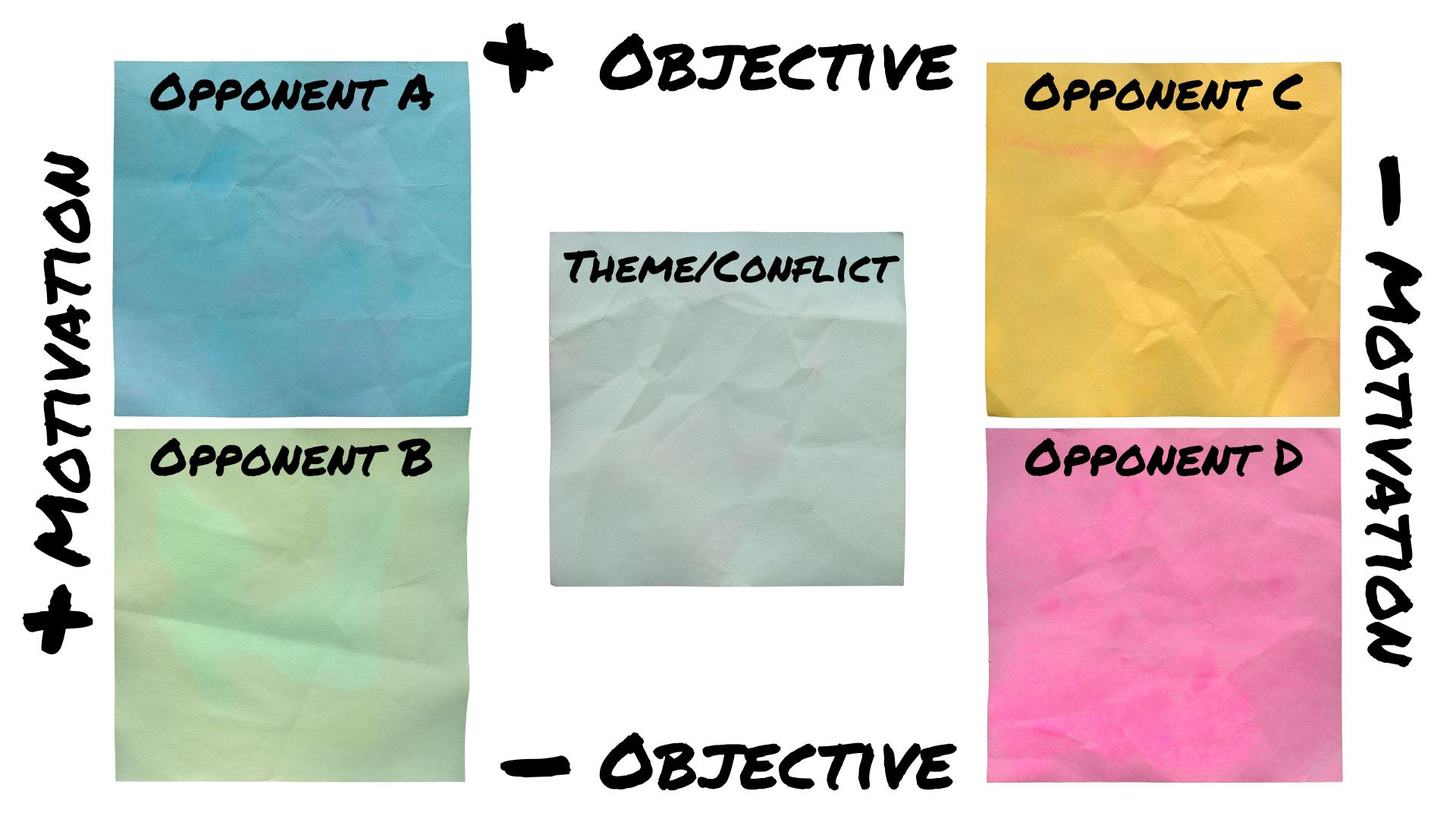
Theme
Start with a THEME (basically, some central idea that anchors the conflict). Having this in mind helps us create the various philosophies held by each group. We’re going to need those “values” to bump into each other.
Listen, we aren’t trying to write the next War and Peace here, so let’s keep it simple. I’ve found that a single word or phrase works fine…
Something like…
Family
Survival
Loyalty
Justice
Freedom
Revenge
Tradition
Progress
Ambition
Corruption
There are tons of theme possibilities (and that’s awesome)!
Conflict
Next you need an overarching CONFLICT (or problem) that embodies your theme. A juicy conflict can make things easier in the next step, so take your time here.
Maybe something like…
A powerful artifact has been discovered. Should it be used or destroyed?
The entire kingdom is being torn apart by a violent revolutionary movement.
A shadowy, criminal syndicate is threatening to throw the city into chaos.
Sorcery is powerful, but emerging technology presents a challenge to magic.
The prince has abdicated the throne! Who will step into the power vacuum?
Pro Tip: Sometimes the conflict comes to mind first, and the theme follows, and that’s OK. If you already have an idea for a killer conflict, ask yourself: “What core idea/value is being tested here?” That’s your theme.
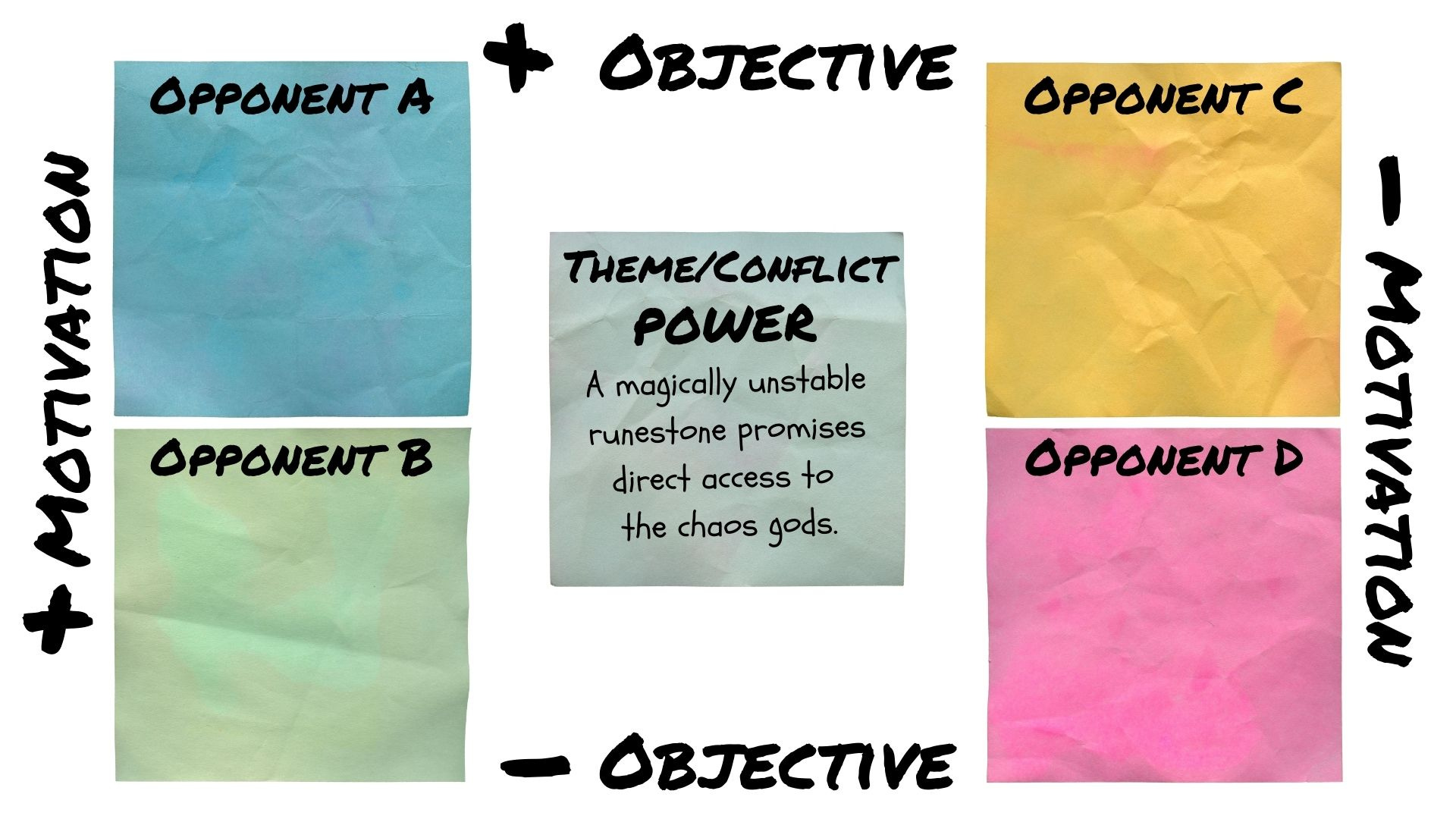
Objective & Motivation
Remember how each group should represent a unique perspective on the theme?
Well, the easiest way to do this is to boil down each faction's “values” by defining its
OBJECTIVE (“What does the faction want to achieve through the conflict?”)
and
MOTIVATION (“Why do they want such an outcome?”).
These objectives and motivations should be crafted as either POSITIVE or NEGATIVE.
Positive Objectives are usually protective or lawful while a negative one is more destructive or unethical or maybe obtained by an “any means necessary” approach.
Positive Motivations are often altruistic or for the greater good while negative ones are self-serving or cruel (think: revenge).
Example
Theme: Control
Conflict: A criminal syndicate threatens to throw the city into lawless chaos.
Positive Objective: Dismantle the syndicate.
Negative Objective: Seize leadership of the syndicate.
Positive Motivation: Protect the innocent from crime and exploitation.
Negative Motivation: Gain wealth and influence through control of the underworld.
Pro Tip: Don’t get too hung up on these adjectives. Switch perspectives and what’s “positive” and “negative” drastically change. No one needs to see (or understand) these labels. Use them only as a means to help you develop opposing views.
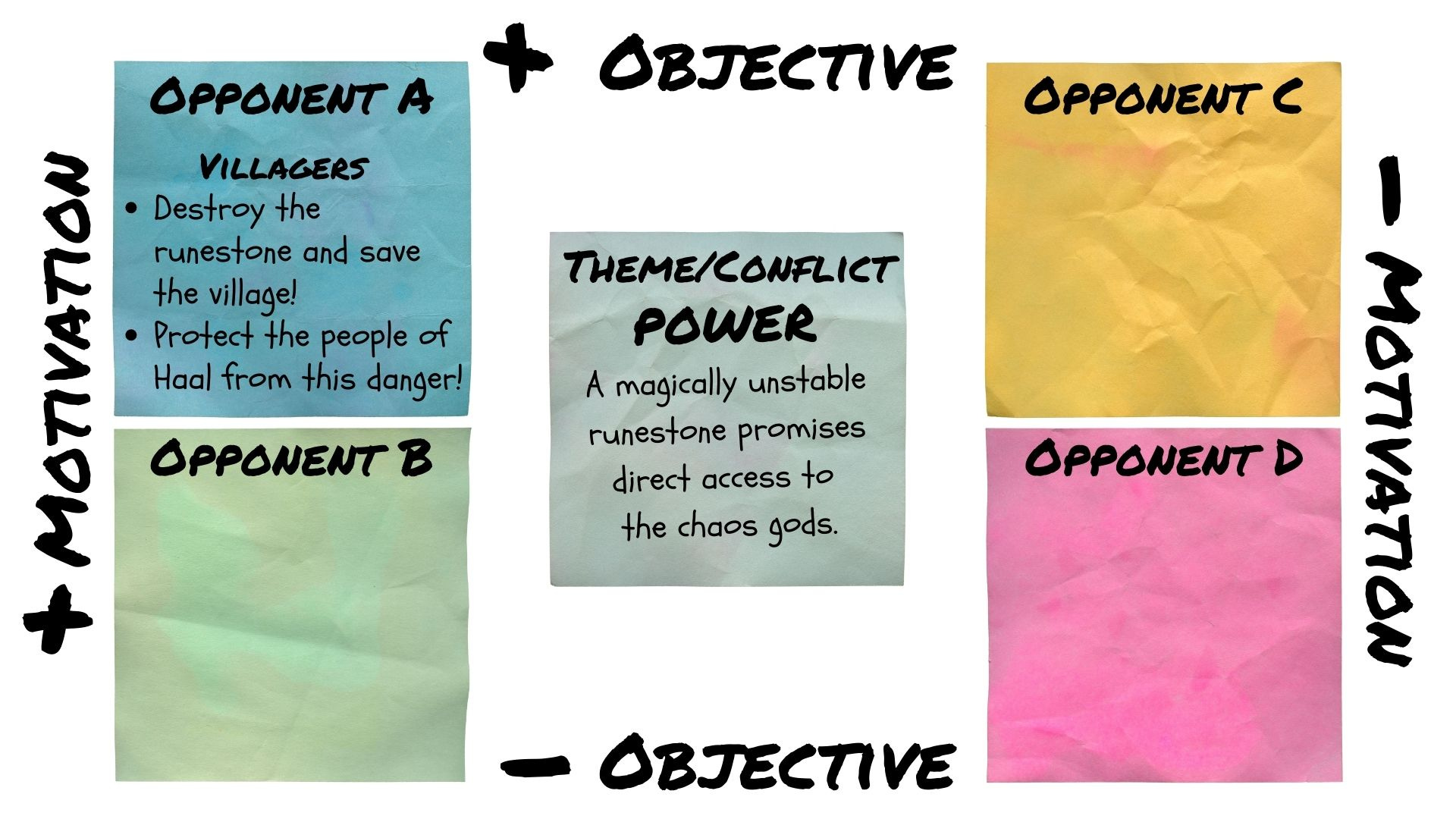
“Opponent A”
With your theme and conflict in hand (and an understanding of positive/negative Objectives and Motivations), you’re ready to start building your first faction.
Opponent A should be the most straightforward "heroic" group—a faction who approaches the conflict with both a Positive Objective and a Positive Motivation. Basically, this means they want to achieve something relatively beneficial, and they are driven by noble intentions. In Truby’s version, he places the “Hero” (the story’s protagonist) here.
I like to make this group first because it can serve as a kind of moral compass for the setting (although they might still be flawed), After Opponent A is done, the others just seem to fall into place.
Other Factions
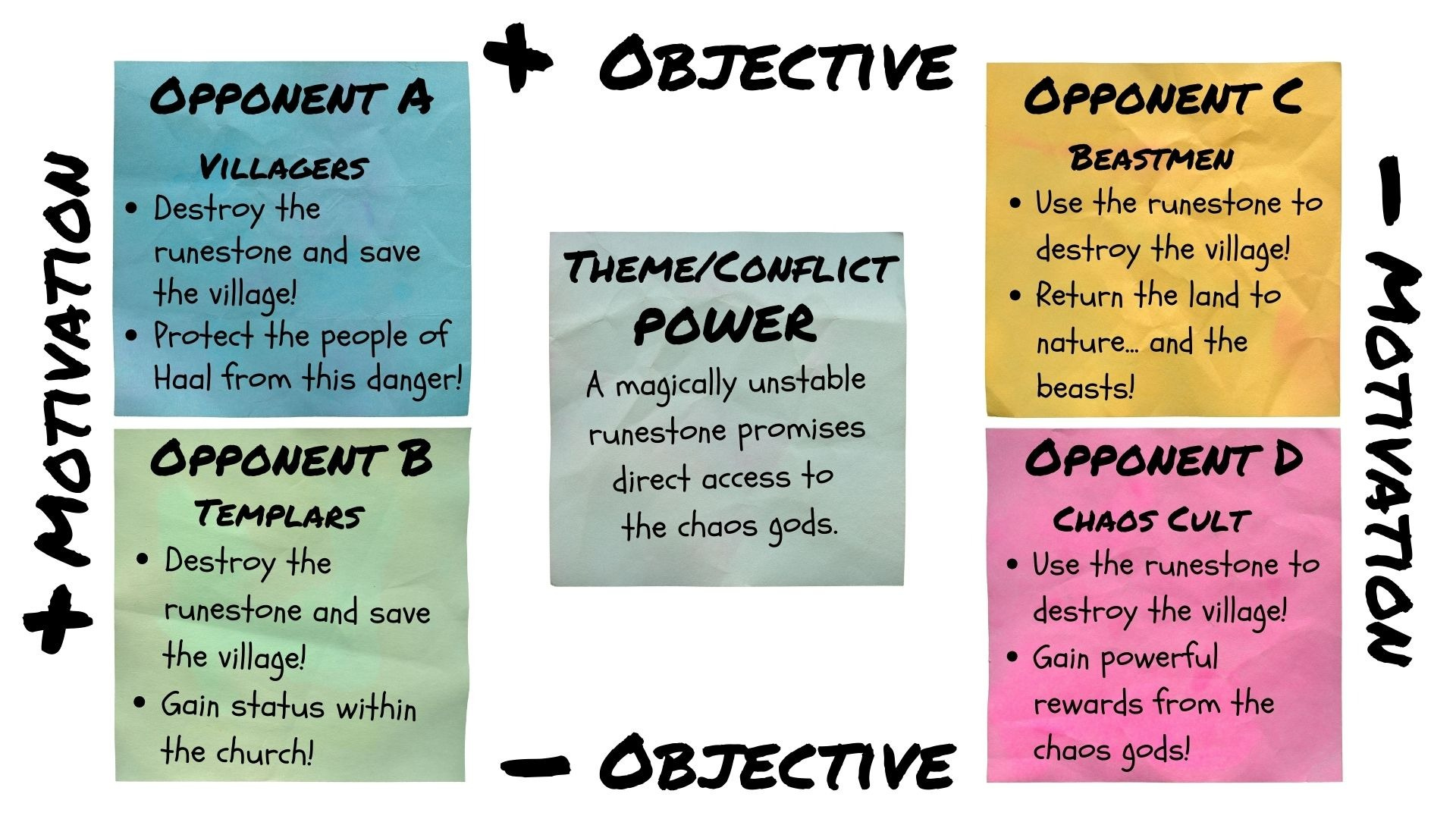
Using this structure, now build your other three factions.
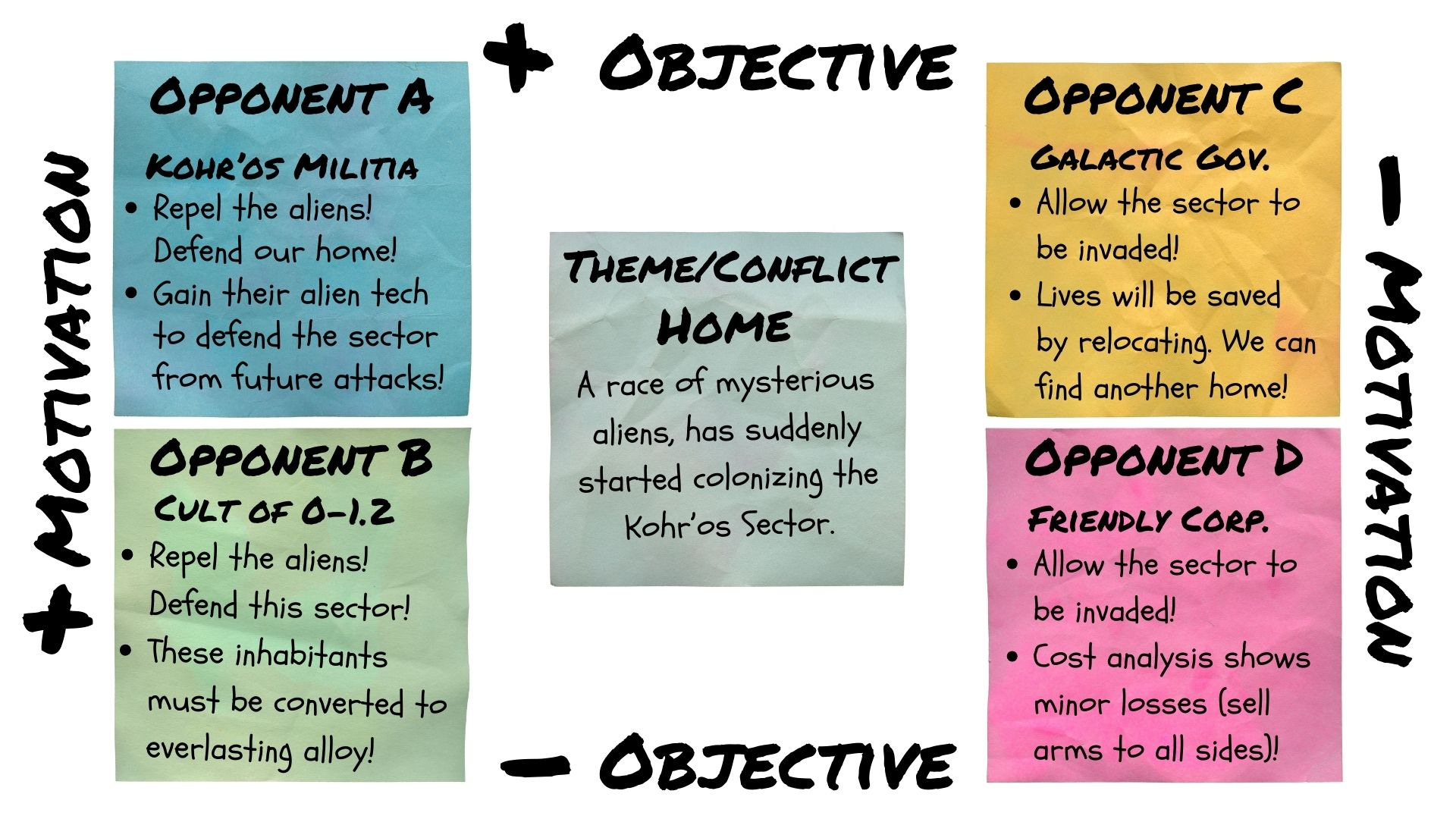
Opponent A: Positive Objective / Positive Motivation(Complete!)Opponent B: Positive Objective / Negative Motivation
Opponent C: Negative Objective / Positive Motivation
Opponent D: Negative Objective / Negative Motivation
It should end up something like this (see graphic below)…
Faction Depth
Once you’ve got a faction for each of your four corners, it’s time to flesh them out a little further.
Where Are They Located?
Do they have a headquarters?
What is the (typical) environment preferred by the faction?
Are they connected emotionally, culturally, and/or historically to some area (city/district, natural landmark, etc.)?
What Do They Look Like?
Do they wear uniforms, symbols, or specific colors?
Are there common physical traits (scars, tattoos, a missing thumb, etc.)?
Do they stick to a certain style (ornate robes, plate armor, masks, Chuck Taylors)?
Who Are Their Leaders?
What are their names?
What do these leaders look like?
What character quirks make them interesting?
Pro Tip: Don’t overdue it here. Runehammer Games creator (and all-around cool dude) Brandish Gilhelm is always saying to “plan for the next session” only (not the campaign). And I think that might be the best advice I’ve ever heard as a Game Master. That applies to building factions, as well. You want just enough details to give each faction a little depth. Leave plenty of room for organic, as-needed, development during play.
Make Factions Work For You!
Using the Four Corners framework in the early stages of design allows the game world to unfold. An NPC, a location, a minor conflict… one thing leads to another as the connections spark new ideas.
And, as a game master, I find that I use way less brain-energy leading a Four Corners game—the flexibility lets the narrative develop organically. (And it doesn’t really feel like improving, either.)
Once Your Four Corner Factions are in Place…
You Know The NPCs
Every NPC will have some perspective on the conflict, a relationship to one faction or another. Are they Supporting members? Neutral Abstainer? Distant sympathizers? Vengeful enemies?
This means NPCs will act predictably toward (or react to) the player-characters based on faction loyalties. Even minor characters will, at least, share their opinions. And, with the Four Corners framework established, you already know what they’ll say.
You Know The Factions
Take another look at that graphic organizer, and you can see how the factions might work together… or against each other.
The groups on each side share an objective or motivation (at least they are both positive or negative, anyway), so players could possibly persuaded these factions to work together. For that same reason, these groups could be pitted against one another.
The opponents situated diagonally, however, hold drastically opposing views. These factions absolutely hate one another—eager for the conflict to boil over into direct confrontation.
So, the framework makes factions react predictably to player-character actions. It also sets up a clear path for faction “moves” outside of player involvement. Between sessions it will make sense for one Opponent D to execute their big plan or Opponent B to shift alliances. As these factions (and their values) bump into each other, it creates interesting problems for the players to solve.
You Free Up the Players
In the original Truby graphic organizer the “hero” takes up one of the Four Corners, but we are not gonna do that. Nope. The player-characters need to start outside of the framework. This is super-important.
We want the PCs to step into the middle of the conflict.
This allows them to:
Fight against a faction they choose to oppose.
Investigate the factions and choose which one aligns with their own characters.
Ally with (or manipulate) factions to gather resources, knowledge, or protection.
This is the real beauty of the Four-Corner Opposition. Instead of telling the players what their story should be, you’re giving them the freedom to shape it themselves.
You Know It’s Tru-by

“The trick to creating a great story,” Truby writes, “is not to make a hero and a villain but to create a network of characters who force the hero to make difficult moral choices.”
In tabletop RPG terms, a game must present a conflict and leave space for players to make difficult (or at least interesting) choices rather than just hacking through everybody and everything murder-hobo-style.
The Four Corner Factions framework does this.
Look, I can’t be the first to use Truby’s concept in this way, but I’ve found it to be helpful in creating unforgettable factions that go beyond Good Guys vs. Bad Guys. So, I wanted to share my process.
Give it a go!
Create your own Four-Corner Factions and share in the comments!
This is really good! Well-designed factions are critical for an immersive game world. I like this structure.
I really like this. I'm looking at combining it with the Core Sync ideas for CfB games. I think this might help with dungeon level development for Beneath Ahknoor - not to mention my old school campaign.